
Artificial intelligence entered organizations before many of them could define clear rules for its use. Employees are already turning to generative assistants, copilots, analysis tools, and autonomous agents to draft copy, review contracts, generate code, summarize meetings, and process spreadsheets.
The problem is not the use of AI itself. The problem lies in usage that occurs without inventory, without risk criteria, without access controls, and without documented evidence. This behavior is known as Shadow AI: the use of artificial intelligence tools that are unauthorized, unapproved, or outside the organization's formal oversight.
What is Shadow AI
Shadow AI is the evolution of shadow IT. Previously, an employee might install an unapproved application on a corporate laptop. Today, they can paste a confidential agreement into a public chatbot, upload a customer database to an AI analysis platform, or connect an autonomous agent to internal corporate systems without any prior assessment.
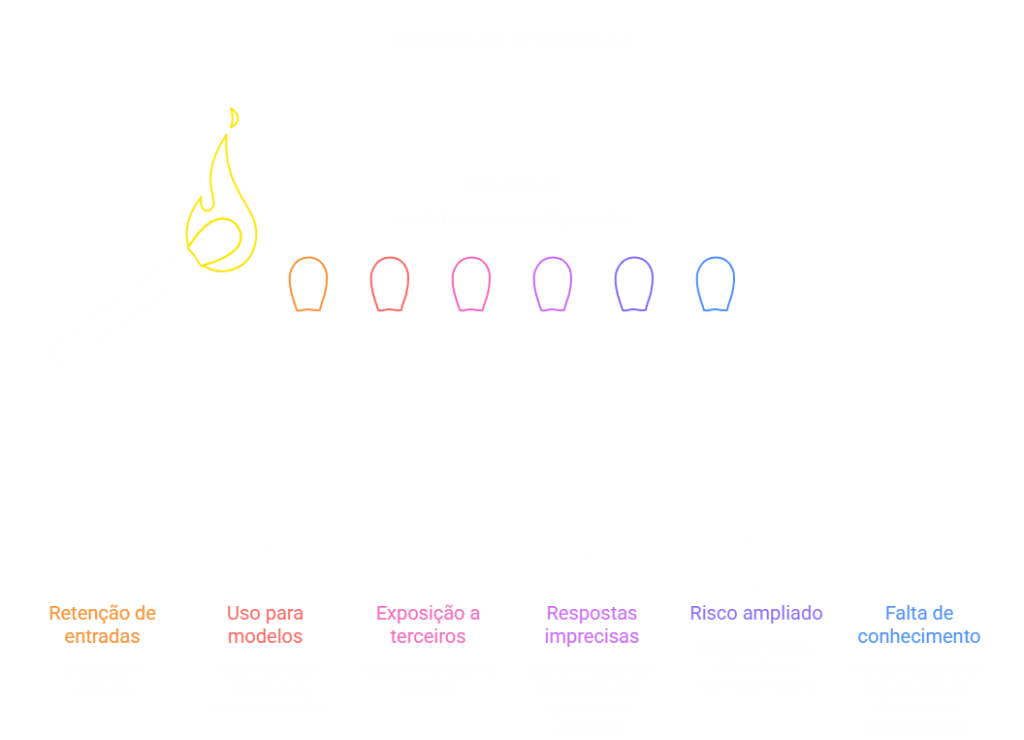
The distinction is critical. Generative AI tools can retain prompt inputs, utilize submitted content to train and refine models, expose proprietary data to third parties, or produce inaccurate outputs with the appearance of authoritative certainty. The risk, therefore, is not limited to an isolated file leak. It permeates corporate decisions, core processes, and institutional accountability.
Several scenarios have become commonplace in corporate daily routines:
- Commercial data in public chats: An employee enters customer information into a public assistant to generate a sales executive summary.
- Confidential contract review: The legal department utilizes external AI to review contracts containing strict non-disclosure clauses.
- Proprietary code exposure: A software engineer sends proprietary source code snippets to a third-party code generation platform.
- Unmonitored HR screening: Human Resources deploys AI for resume screening without establishing criteria, human review, or a defined legal basis.
- Agents with unconstrained access: Finance builds automations with autonomous AI agents that interface with internal ERP systems without granular permission controls.
In all these cases, the organization may have no visibility into what data was shared, with which external vendor, for what purpose, and under what contractual or technical safeguards.
The Scale of the Problem
Market data demonstrates that Shadow AI is already widespread corporate behavior, rather than an isolated exception.
According to UpGuard's State of Shadow AI report, 81% of surveyed employees reported using unapproved AI tools in the workplace. In PagerDuty's study involving 1,250 enterprise professionals, 66% admitted to using AI even when believing company policy prohibited it. Furthermore, the same study revealed that 88% shared work-related information with public AI tools.
In Brazil, the reality follows this global trajectory. A nationwide survey indicates that 82% of Brazilian companies acknowledge employees utilize third-party AI tools at least occasionally without formal approval or corporate oversight.
Among the direct impacts reported by Brazilian organizations are:
- Inconsistent or inaccurate outputs (hallucinations): 50%.
- Data leakage or intellectual property exposure: 43%.
- Information security vulnerabilities: 32%.
- Regulatory and compliance violations: 31%.
Why the Risk Surpasses Traditional Shadow IT
Traditional Shadow IT typically involves unapproved desktop software, cloud storage drives, or SaaS services. Shadow AI adds significantly more complex layers of risk:
- Expanded data ingestion and processing: Many AI platforms consume raw text, legal documents, images, codebase repositories, and operational context. Without robust data processing agreements and technical safeguards, sensitive corporate intelligence is processed outside the corporate security perimeter.
- Decision opacity (the black box problem): An AI model can produce a recommendation, classification, or automated decision that directly shapes a business negotiation, candidate hiring process, credit underwriting, or customer support triage. Without version tracking, documented prompt history, training datasets, and human review, organizations struggle to demonstrate how conclusions were reached.
- The rise of autonomous agentic AI: The shift from conversational generative AI to autonomous agents capable of executing multi-step workflows magnifies exposure. An agent can access APIs, trigger system integrations, and perform automated actions with minimal or no human supervision. Recent research shows that nearly three in ten corporate workers already employ unsanctioned AI agents on the job.
Impact on LGPD, Privacy Laws, and Corporate Governance
Under the lens of privacy legislation like the LGPD (and GDPR), Shadow AI can turn an apparently simple task into unlawful personal data processing. Organizations must demonstrate purpose, legal basis, data minimization, security, accountability, and the ability to fulfill data subject rights.
When an employee inputs personal data into an unapproved AI tool, the company loses visibility over:
- Which specific personal data was disclosed.
- The exact purpose and scope of the processing.
- Who the processing vendor is and what contractual safeguards they provide.
- Whether international data transfers are taking place.
- How long the data remains retained or stored by the vendor.
- How to detect, contain, investigate, and report potential security breaches.
This undermines institutional accountability. Having a static privacy policy is insufficient. Organizations must be able to demonstrate, through auditable evidence, that they understand their data flows and maintain risk-proportionate controls.
Blanket Blocking Is Not Governance
The most common corporate knee-jerk reaction is to block AI tools entirely. In certain high-risk contexts or for tools lacking baseline privacy and security guarantees, targeted blocking is necessary.
However, blanket bans rarely resolve the problem.
When employees face tight deadlines and lack secure, sanctioned alternatives, they invariably find workarounds. The result is more pervasive Shadow AI, zero institutional visibility, and a widening chasm between official policies and everyday operational practice.
Effective governance operates on a different premise: organizations must build secure pathways for legitimate, high-value use cases while establishing firm guardrails against hazardous practices. This requires:
- Vetting and approving AI tools and vendors against rigorous security and privacy criteria.
- Defining permissible data categories for specific models and contexts.
- Establishing formal workflows for requesting, evaluating, and approving AI use cases.
- Providing enterprise-grade corporate alternatives for productivity, analytics, and automation.
- Continuously monitoring AI usage patterns to detect anomalies.
- Maintaining auditable records of approvals, decisions, incidents, and compliance evidence.
AI Governance as the Strategic Solution
AI Governance is the integrated system of policies, roles, processes, technical controls, metrics, and evidence that allows an organization to deploy artificial intelligence responsibly, securely, traceably, and in alignment with legal and regulatory obligations.
It does not mean creating parallel corporate bureaucracy. The most effective strategy is integrating AI governance seamlessly into established frameworks for privacy, information security, enterprise risk management (ERM), architecture, and corporate compliance.
Two major international benchmarks guide this effort:
- ISO/IEC 42001:2023: Establishes requirements for an Artificial Intelligence Management System (AIMS), covering governance leadership, risk assessment, data quality, lifecycle management, monitoring, and continuous improvement.
- NIST AI RMF: Guides organizations in identifying, measuring, managing, and governing risks across the entire lifecycle of AI systems.
What Organizations Must Govern
A mature AI governance program must address, at a minimum:
- AI Inventory: which models, copilots, analysis platforms, and autonomous agents are in use, by whom, and for what purpose.
- Risk Classification: which use cases involve personal data, decisions affecting individuals, proprietary IP, critical infrastructure, or high business impact.
- Acceptable Use Policy: clear guidelines on permissible activities, approval thresholds, and strictly prohibited applications.
- Pre-deployment Assessment: evaluation of security architecture, privacy impacts, vendor terms, algorithmic bias, and compliance readiness prior to rollout.
- Technical Controls: enterprise authentication, role-based access control, environment segregation, encryption, telemetry logging, data loss prevention (DLP), and runtime monitoring.
- Human Oversight: defining clear thresholds where automated AI recommendations or actions mandate human-in-the-loop validation.
- Incident Management: robust procedures to detect, document, contain, investigate, and notify stakeholders of AI-related failures or breaches.
- Compliance Evidence: immutable records supporting internal audits, third-party vendor reviews, supervisory authority inquiries (such as ANPD), and client due diligence.
From Visibility to Control
The first step is not purchasing another point solution or publishing a generic usage policy. It is gaining unvarnished visibility.
The foundational question is simple: how much AI is already active within our organization today—both officially and unofficially?
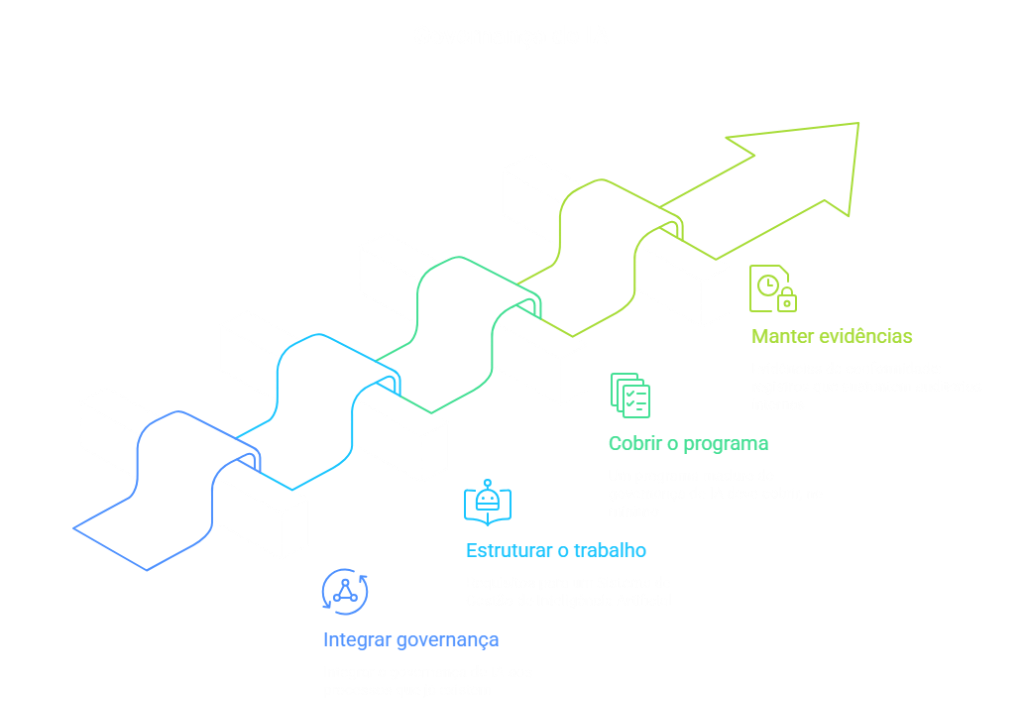
With that baseline in hand, companies can transition to a continuous governance lifecycle:
- Discover: map all tools, operational use cases, third-party integrations, and autonomous agents in flight.
- Classify: evaluate risks based on processed data tiers, business impact, criticality, and legal exposure.
- Approve: validate business use cases against formal, objective criteria and risk thresholds.
- Control: enforce granular access policies, data minimization pipelines, and principle of least privilege.
- Monitor: track operational usage, identify behavioral deviations, log anomalies, and evaluate performance.
- Evidencing: capture decisions, approvals, periodic reviews, and remediation actions within immutable audit trails.
This continuous cycle transforms AI from an invisible, distributed liability into a well-governed, competitive strategic asset.
How DPO Privacy Supports This Journey
The AI Governance module by DPO Privacy was engineered specifically to structure this lifecycle, seamlessly bridging AI governance with your organization's existing privacy, compliance, and enterprise risk management ecosystem.
The platform centralizes critical capabilities, including:
- AI Use Case and Model Catalog: centralize and maintain a live inventory of all deployed algorithms and platforms.
- AI Policy & Governance Rules: formalize corporate boundaries, roles, escalation pathways, and acceptable use guidelines.
- AI Risk Assessment: systematically analyze tools, models, and workflows prior to adoption and throughout runtime.
- Continuous Compliance Monitoring: track regulatory alignment, monitor drift, and surface non-compliant deviations across system lifecycles.
- AI Incident Management: integrate incident logging, containment workflows, and compliance reporting in one hub.
- Shadow AI Detection: identify unapproved tools and unauthorized usage across organizational channels.
- EU AI Act & Global Regulatory Alignment: map controls and generate evidence directly against evolving international legal mandates.
Conclusion
Shadow AI will not vanish because of a corporate memo. It recedes when leadership acknowledges that artificial intelligence is already woven into everyday business operations and resolves to govern it with the same rigor applied to data, cybersecurity, and financial controls.
The strategic question is no longer “should we allow AI?”. The only question that matters is: how do we deploy AI with visibility, control, accountability, and auditable evidence?
For organizations striving to balance innovation with regulatory compliance (such as LGPD and EU AI Act), information security, and brand trust, structured AI governance is the definitive path to transforming AI into a sustainable competitive advantage rather than a silent threat.
The DPO Privacy AI Governance module delivers the robust infrastructure required to inventory, assess, govern, and evidence artificial intelligence across your enterprise on a single, integrated platform.


